Biobased materials in interior design: what are they and why do they make a difference?
What makes biobased materials so interesting?
The choice of materials plays a crucial role in the climate impact of an interior. Biobased materials offer an alternative to traditional fossil-based raw materials because they come from renewable sources such as wood, flax, hemp, bamboo or mycelium.
These materials are part of the biological cycle and can often re-grow within a relatively short period of time. As a result, they contribute to reducing resource scarcity and CO₂ emissions.
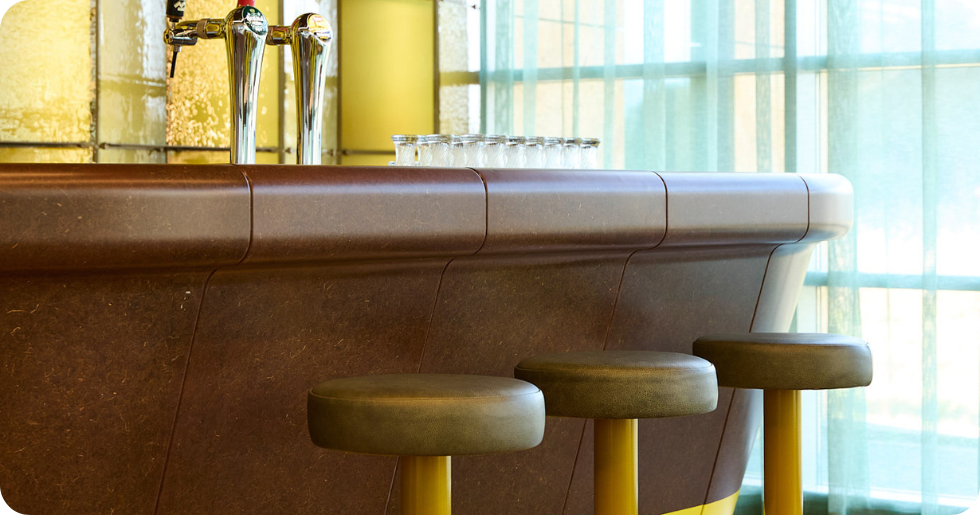
For Brunel, we worked with the Nabasco bio-composite, consisting of natural fibers such as flax and hemp, combined with a biobased resin. This material combines technical performance with a lower environmental impact and fits into circular design strategies.
CO₂ storage and healthy indoor climate
Many biobased materials store CO₂ as they grow. As a result, the total carbon footprint of an interior can be significantly lower than traditional materials.
In addition to climate benefits, biobased materials often contribute to a healthy indoor climate. They generally have a low emission class (E1/E0), regulate humidity, improve acoustics and provide a natural look. This creates a comfortable and healthy environment for users, while at the same time reducing the environmental impact.
Materials such as cork, linoleum and bamboo combine functional properties with aesthetic quality and support an integrated design approach that combines sustainability, comfort and appearance.
“An interior that is good for people can also be good for the Earth.”
Nevertheless, the use of biobased materials is still under development. Availability, certification and knowledge sharing are still challenges. But innovation is fast. More and more parties are discovering how these natural raw materials can be applied on a large scale, from biobased panels to acoustic panels from waste streams.
The role of biobased in circular design
Biobased materials are increasingly being used in circular construction because they are in line with important circular principles such as the use of renewable raw materials, regenerative design and reducing the environmental impact. In addition, they make it possible to cascade materials, where raw materials are used in multiple applications and thus retain their value for as long as possible. As a result, biobased materials contribute to a more sustainable and future-proof interior.
When biobased materials are combined with modular and demountable design, a system is created in which materials can go through multiple applications. Making material origin transparent via material passports or Digital Product Passports will make reuse easier in the future.
The application of biobased materials requires knowledge of performance, maintenance and longevity. That is why we work with suppliers and producers to optimally use materials in various projects.
This creates an interior that is not only sustainable today, but is also prepared for future circular applications.
.png)