From old town hall to new interior: circularity in practice at Smallingerland
How do you realize a completely renovated town hall while ensuring that as much value as possible is retained from the existing building? For the municipality of Smallingerland in Drachten, Zwartwoud is working on the custom interior of the renovated town hall. It is a project where sustainability is visible not only in the choice of new materials, but precisely in what does not need to be made new.
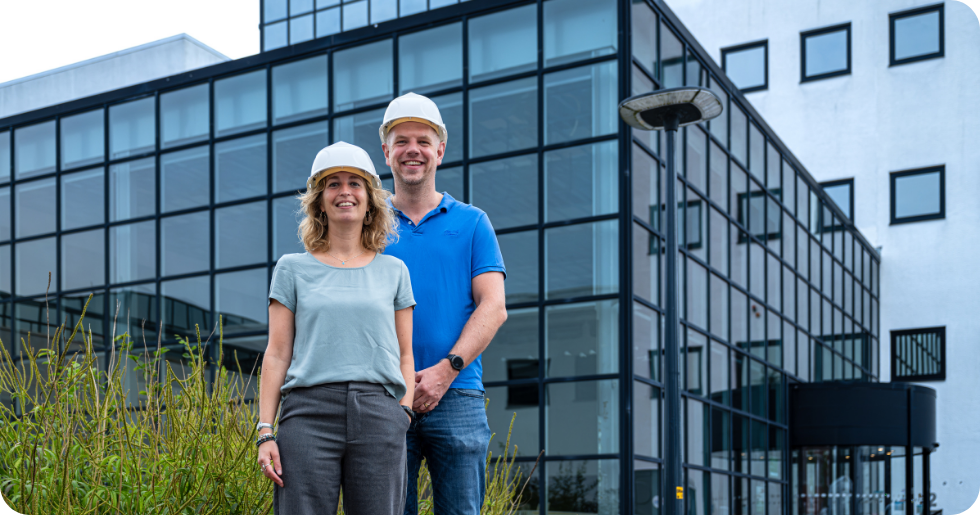
Zwartwoud was selected for the project's custom interior through a tender process. During the project, they worked closely with ZENBER Architects to critically examine the specified materials. Various material choices were reviewed, and more sustainable alternatives were proposed wherever possible. These recommendations ultimately became an important part of the final design development.
“The collaboration with ZENBER is very direct,” says project coordinator Roosmarijn Punt. “The architect is open to us contributing ideas about product development and sustainability. Sometimes that means pioneering. You take a step forward, discover something new, and sometimes have to take a step back. But it is precisely by continuing to search together that you ultimately arrive at a better solution.”
Harvesting instead of discarding
An important part of the project began even before the production of the new interior started. When the existing town hall was being cleared out, Zwartwoud investigated which components were suitable for reuse.
That sounds simple, but in practice, it initiates an extensive process. First, an inventory is made of what is present and what has the potential for reuse. Then, materials must be carefully dismantled, transported, assessed, and stored. Only then can it be determined where they can be given new value within the new design.
‘“Variety and challenge. That’s what makes the work interesting for me.”’ – Jan de Vries, Project Manager
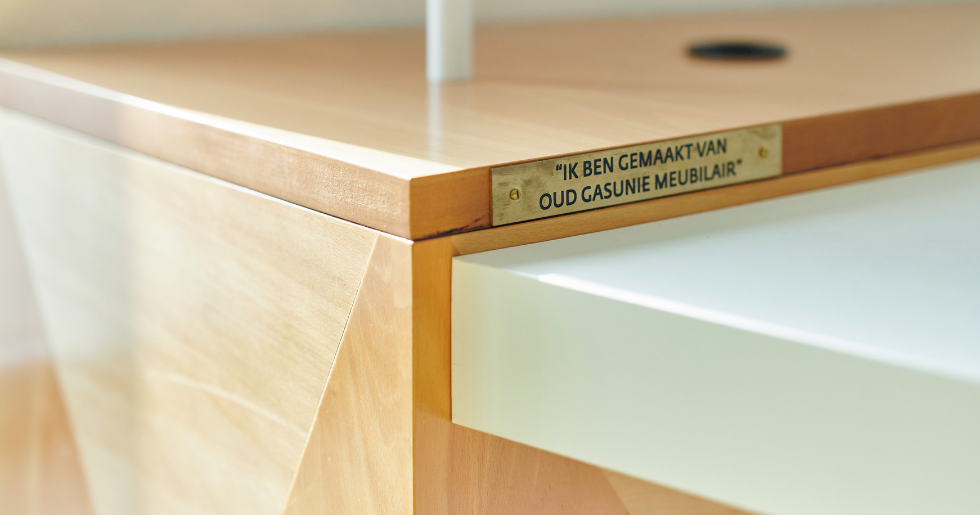
For Smallingerland, existing cabinets were among the items harvested. These were dismantled by Caparis, after which the materials were sorted and stored. The old cabinet parts are now being given a new application as carcasses and non-visible components of new custom work. Structural parts for new seating furniture are also being made from previously dismantled sheet material.
This gives a new function to material that might otherwise have been disposed of as waste.
“When the desire for reuse became concrete, we had to switch gears quickly,” says project leader Jan de Vries. “The remediation was going to start soon. We therefore looked at what materials were present, what was suitable for reuse, and how we could organize that.”
It shows that circular working does not start the moment a new piece of furniture is produced. It starts much earlier, with the question of what is already available.
The harvesting process was set up by the Zwartwoud project team. Inventories and floor plans were made in advance. Materials were then collected on pallets and transported to Caparis for dismantling. Afterward, the project team reassessed which parts were actually usable. Everything that proved suitable was included in an extensive harvest list. That information then went to production planning so that the available material could actually become part of the production.
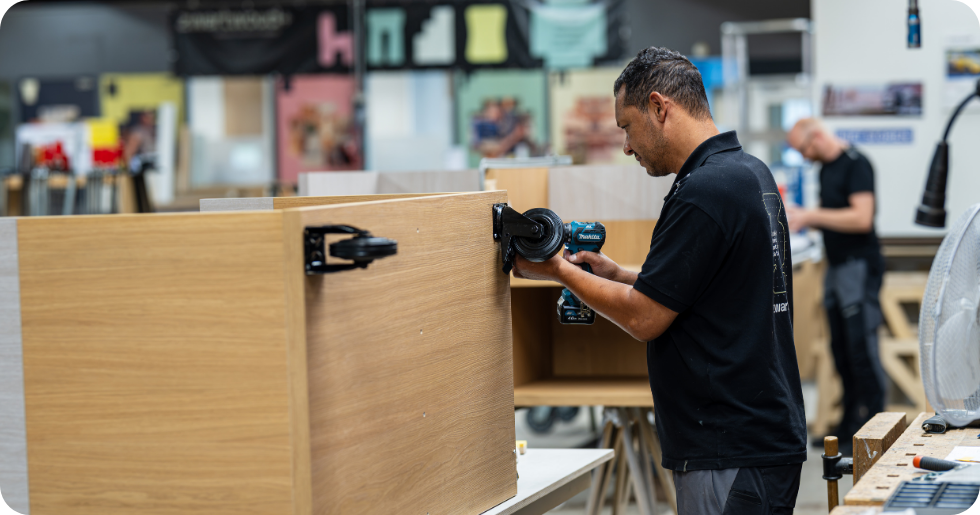
The collaboration with Caparis also adds an extra dimension to the project. By outsourcing part of the dismantling, circularity is combined with Social Return. This way, it is not just about preserving materials, but also about creating social value.
Circular building is also about organization
It is precisely in this practical execution that a significant part of the knowledge required to turn circular ambitions into reality lies. According to the project team, harvesting is difficult to capture in a single standard process. Every building contains different materials, and every design subsequently requires a different application for them.
“Every harvest yields something different,” Roosmarijn explains. “And the application is different every time, too. In fact, even the harvesting itself is bespoke.”
This brings a logistical challenge. Harvested materials must be transported and stored temporarily before it is clear where they will be reused. In the case of Smallingerland, materials are stored both at Zwartwoud and at external locations. At the same time, an exact record must be kept of what is available, its condition, and what it can be used for.
And when the new custom-made items finally head to Drachten, the next logistical puzzle begins. How many parts fit on a pallet? How many pallets fit in a truck? When can delivery take place on-site? Is the elevator large enough for the custom items, and will it be available at the right time?
‘In fact, even the harvesting itself is bespoke.’ – Roosmarijn Punt, Project Coordinator
These are questions that might seem unrelated to sustainability at first glance, but they are decisive for the success of a circular project. After all, a sustainable design only works if it is also technically, logistically, and financially feasible.
That is why, throughout the project at Zwartwoud, there is continuous coordination between project management, estimation, work preparation, production, and assembly. Problems must be identified as early as possible so there is still room to find solutions.
For Jan and Roosmarijn, Smallingerland is also a special project on a personal level. It is the largest circular project they have carried out together at Zwartwoud to date, and the first time they have been responsible as a project team for harvesting and reapplying existing materials on this scale.
That experience yields new knowledge that can be applied to future projects. Because although no two circular projects are the same, processes can be continuously improved through experience.

.png)