From disruptor to the standard: Karst Wouda on the future of Zwartwoud
According to director Karst Wouda, describing Zwartwoud merely as an interior builder no longer does the company justice. In recent years, the organization has grown significantly, fully committed to sustainability, and increasingly taken on a role at the front end of complex interior projects. At the same time, the ambition to share knowledge, connect parties, and further integrate circularity into the market continues to grow.
And this is happening while some of the 2030 goals have already become reality, according to Wouda.
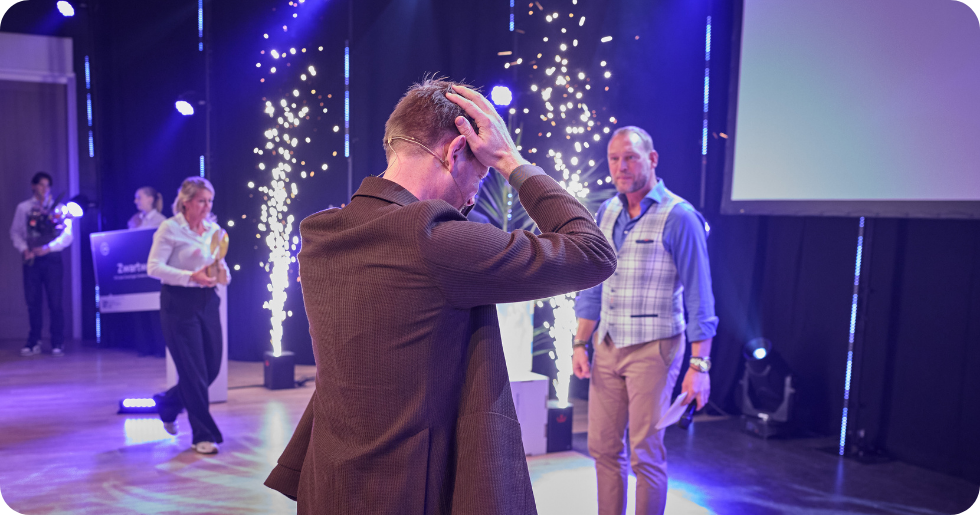
'We had set a goal on the horizon with a strategy and objectives for 2030. Due to the acceleration that has taken place within our organization and how the outside world is responding to it, things have really sped up. In 2026, we are already partially living in 2030 because we have already achieved quite a few of our goals.'
According to him, this does not mean it is time for a new course. 'A radical change in direction? Absolutely not. We are right in the middle of it, and there is still a lot to be achieved.'
The next step, according to Wouda, lies primarily in further developing and sharing knowledge and innovations, and intensifying collaborations within the supply chain. New technology can play a role here, for example by making material passports smarter and more intelligent using AI. But his ambitions go further. For instance, he sees opportunities for a circular factory where various parties work together on new solutions.
'It is now about becoming even better at what we do and maintaining our lead.'
Not an interior builder, but a circular interior developer
That ambition fits a change that has been underway at Zwartwoud for some time. The traditional image of an interior builder who receives a drawing and then produces the requested custom work is, according to Wouda, increasingly out of step with daily practice.
'You are right to say: we are not an interior builder. We never really were, because we have always had a development team at the front end. I see us as a circular interior developer.'
It is precisely this position at the start of a project that is becoming increasingly important. Zwartwoud works with architects and clients to think through the realization of an interior, where, in addition to materialization and construction, CO₂, modularity, and the reuse of raw materials also play a role. According to Wouda, the product development department at the front end has grown by forty percent in two years.
Project management is also changing as a result. A project manager is increasingly organizing more than just planning, production, and installation. Think of inventorying existing interiors, dismantling and temporarily storing usable parts, and organizing reuse. Materials that cannot be redeployed must ultimately return to the raw material stream as responsibly as possible.
'That is a completely different issue than: this is the table that needs to be made, this is what it looks like, and it must be ready by this date. The latter is what the traditional interior builder does.'
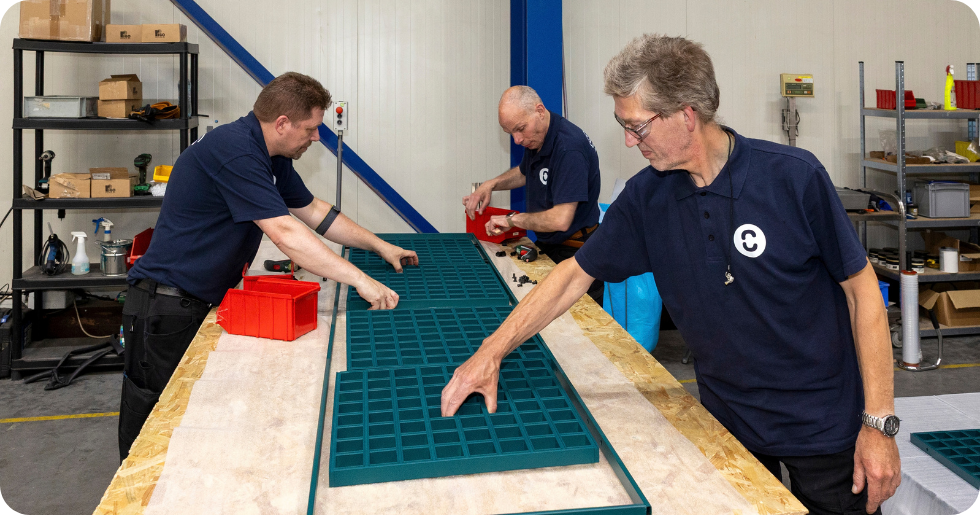
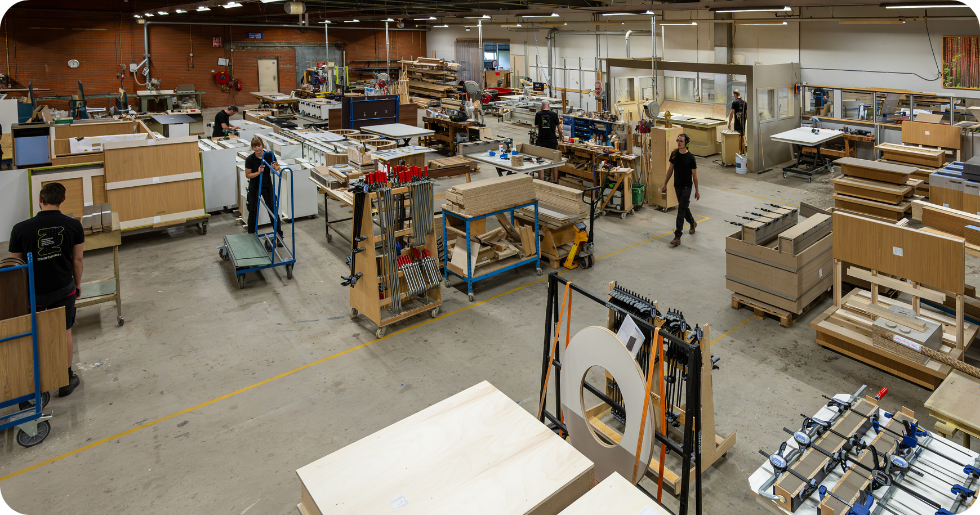
Wouda also sees opportunities in production to further extend this development. Refurbishing more products and making them reusable, performing additional disciplines in-house, and collaborating more with people distanced from the labor market during installation and assembly are examples he mentions.
The sustainable alternative must always be on the table
Not every client is at the same stage yet. Zwartwoud consciously focuses on corporates, government agencies, and architects because sustainability is increasingly high on their agendas. At the same time, Wouda sees opportunities in sectors where this development is less advanced, such as retail and SMEs.
Even when a client still views an interior project in a traditional way, he sees a responsibility for Zwartwoud. It is estimated that approximately seventy percent of revenue is now sustainable.
'I believe we have a moral obligation to bring those clients along as well. We must provide insight into the alternative, what it yields, what it does to the price, and above all, what the benefits are of choosing a sustainable interior.'
In doing so, Wouda also wants to look more emphatically at residual value. After all, when materials or products still represent value after their first phase of use, the financial conversation surrounding an interior also changes.
"When a request is made in a traditional way, we should really commit ourselves to always presenting the sustainable alternative alongside it. You can say: this is optional, but we strongly advise you to choose this option. That is how we can truly be a knowledge partner."
He believes Zwartwoud cannot fulfill that role alone. He wants to seek more connections with start-ups, suppliers, and the education sector. He sees opportunities to make progress, especially through open and equitable collaborations. Connecting with young people is also important. By supporting educational programs, providing lessons, or developing workshops, for example, practical knowledge and new ideas can reinforce one another.
Growth without losing character
At the same time, Zwartwoud itself is changing. The organization has grown by more than fifty percent in a few years and now has over eighty employees. Further growth is possible, but getting bigger is not an end in itself for Wouda.
'Endless growth is not my ambition, but natural growth and making an increasingly greater impact as a company is.'
At least as important is maintaining the character of the organization. Processes have become more professional, and team leaders are playing an increasingly important role alongside the management team. But according to Wouda, you cannot impose culture from the top down.
'Management can have all sorts of great ideas, but people have to feel it, live it, and do it out of intrinsic motivation.' That is why responsibilities are deliberately pushed lower into the organization. For Wouda, that human development is perhaps the result he is most proud of.
'I start with the people. How we have grown as a group, how we treat each other, and the atmosphere here: that is what I am most proud of. I sometimes say that I am the national coach. It is up to me to put everyone in the right position.'
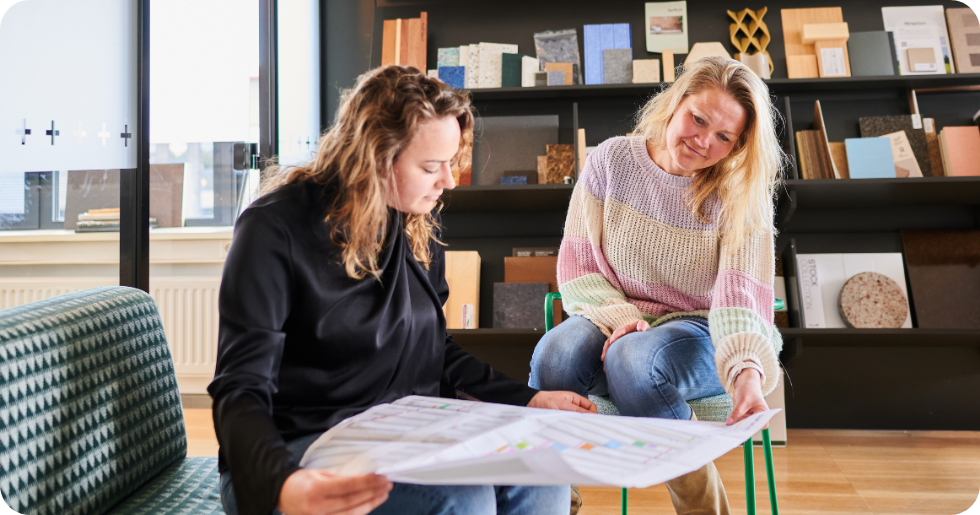
According to him, that culture is also a major engine behind Zwartwoud's development. 'What we have created here over the past few years—safety, fun, a shared goal, and a sense of belonging—has been a catalyst for growth. I can list great projects, but I actually find this more important.'
From disruptor to the standard
If Wouda has to name one ambition still on his list for 2030, it is the development of a circular hub or factory. An environment where multiple parties work together on circular solutions and where there is also room for people who are distanced from the labor market.
'I want to create a situation and environment where education, government, and businesses come together in one place. I would like to be the director and organizer of that to bring it all together, so that we can make a significant impact.' That ambition builds on a choice that was made deliberately a few years ago. Zwartwoud decided to go all-in on sustainability, without knowing in advance if the market would follow suit.
'We chose sustainability with full conviction, but you never know one hundred percent for sure if it will catch on. I am proud that the choice we made back then has become a success.'
While a few years ago Zwartwoud positioned itself primarily as a challenger to the traditional market, that ambition is now shifting, according to Wouda.
'A few years ago, I saw us as a kind of disruptor in the market: we really wanted to do things differently than others. We are now even receiving compliments from fellow competitors on how we are approaching this.'
And what should that ultimately lead to? Karst explains: 'It would be great if, in five years, you could say: Zwartwoud has set the standard in the market. From disruptor to the standard.'